Slab leak detection & repair
Slab Leak Repair in New Braunfels, TX
Warm spot on the floor, water running when every tap is off, or an NBU continuous-use alert? Those are the three most common ways a slab leak shows up.
We confirm the leak first, pinpoint it without breaking floors, then walk you through every repair option before any concrete is touched.
- Licensed by the TSBPE
- Leak found before concrete is cut
- Upfront price before work
- Call to check plumber availability
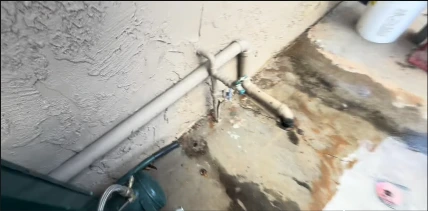
Slab leak warning signs New Braunfels homeowners notice first
A slab leak is a leak in a water or drain line under or inside your concrete foundation. You can’t see it, so you notice what it does to the house. One sign alone can be something else. Two or more is worth a call.
A warm or hot spot on the floor
A leak on the hot water line heats the concrete. You feel it barefoot on tile, or the dog keeps lying in the same spot.
The sound of running water
Hissing or trickling in a wall or under the floor when nothing is running, often easiest to hear at night.
A bill or NBU alert you can’t explain
Usage jumps with no new pool, guests or irrigation, or NBU flags continuous water use at your meter.
Damp flooring or a musty smell
Wet carpet pad, cupping hardwood, darkening grout, or mildew along a baseboard with no leak in sight.
New cracks in tile, walls or slab
Cracked tile, drywall cracks above doors, or doors that suddenly stick. Soil movement and leaks feed each other.
Low pressure or a water heater that never stops
A hot-side leak keeps the heater refilling and reheating, so it runs far more than it should.
What are the signs of a slab leak?
The most common signs of a slab leak are a warm or hot spot on the floor, the sound of running water when fixtures are off, an unexplained jump in your water bill or an NBU continuous-use alert, damp flooring or a musty smell, new cracks in tile or walls, low water pressure, and a water heater that runs constantly.
Is a slab leak an emergency?
It’s urgent but not always an emergency. If water is surfacing through the floor, pooling, or your meter is spinning fast, shut off the main and call right away. A slow leak found by a meter test can usually wait for a scheduled visit, but every day it runs wets the soil under your foundation.
Water coming up through the floor? Close the main shut-off, turn the water heater off (gas to pilot, or the breaker for electric), move rugs and furniture, and photograph everything for insurance. Then see our emergency plumber guide or call (830) 218-7472.
How do I know if I have a slab leak?
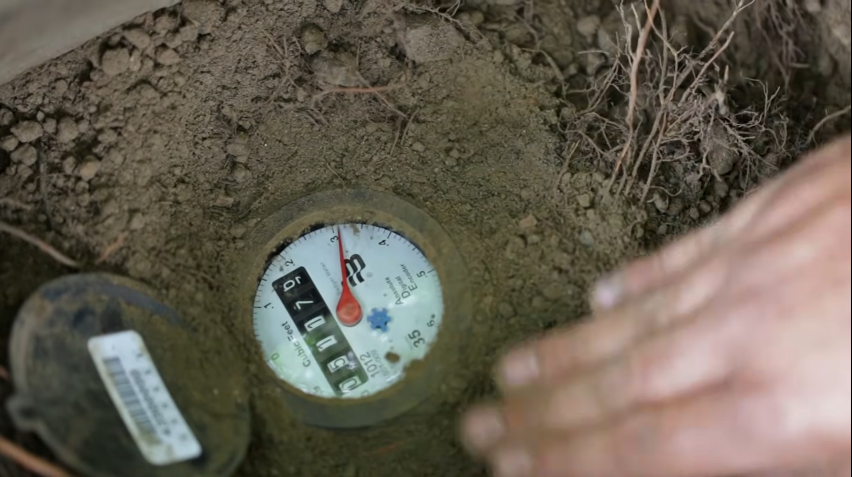
Do a meter test. Turn off every faucet, appliance, irrigation and the ice maker. Look at your water meter’s leak indicator, the small dial or triangle. If it still moves, water is going somewhere. Then close the main shut-off at the house. If the meter stops, the leak is inside the home, possibly under the slab.
The 5-minute meter test
- Turn off all water use: taps, toilets, washer, dishwasher, ice maker, softener and sprinklers.
- Open your meter box (usually near the curb) and watch the leak indicator for 2 to 3 minutes. Not moving? You likely have no active leak.
- Indicator moving? Close your home’s main shut-off valve.
- Watch the meter again and match what you see below.
Meter stops
The leak is inside the house: a toilet, the water heater, or a line under the slab.
Meter keeps moving
The leak is in the yard line between the meter and your house, not under the slab.
Rule out toilets first: a few drops of food coloring in each tank. Color in the bowl after 15 minutes means a flapper leak, not a slab leak.
What NBU’s continuous-use numbers usually mean
Bars drawn on a 0 to 100 gallons-per-hour scale. Ranges from NBU’s continuous water use guide.
Source: New Braunfels Utilities continuous-use guidance. NBU does not repair leaks on the customer side of the meter.
Why slab leaks are so common in New Braunfels
New Braunfels sits on a geological seam. The Balcones Escarpment runs roughly along I-35, and the city straddles two ecoregions: the Blackland Prairie to the east, known for its waxy black clay, and the Edwards Plateau to the west, with thin, limy soils over Hill Country limestone.
Expansive clay swells when it’s wet and shrinks when it dries. Every swing moves the slab a little, and the copper or PEX lines inside or under it move with it. Over years, that movement, plus friction where a pipe rubs concrete or gravel, opens pinhole leaks and cracked joints.
A local plumber quoted by Community Impact described the cycle: a leak wets the soil, the soil shifts, and the shifting can break more pipe. That’s why we treat a slab leak and foundation movement as one problem with two trades, not two separate jobs.
The local numbers
- Residential foundation repair permits in New Braunfels rose nearly 118% from 2018 to 2022, according to the City’s building official.
- The drought began in October 2021, and Central Texas saw record foundation repairs in 2022.
- The city spent nearly a year in Stage 3 water restrictions before moving to Stage 2 on May 29, 2023.
Source: Community Impact, July 14, 2023.
Why do so many New Braunfels homes get slab leaks?
New Braunfels straddles the Blackland Prairie’s expansive clay and the Edwards Plateau’s limestone. Clay swells when wet and shrinks in drought, moving the slab and the pipes inside it. After the 2021 to 2023 drought, the City reported residential foundation repair permits up nearly 118% from 2018 to 2022. Moving soil stresses pipes and opens leaks.
East or west of I-35?
Soil changes lot by lot, so we don’t guess from your ZIP code. Homes on deep clay tend to see more slab movement than homes sitting closer to limestone, and that affects which repair we recommend for your house.
How we find a slab leak before breaking any concrete
Breaking the wrong spot is the most expensive mistake in slab leak repair. Here’s how the search narrows from “somewhere under the house” to a spot you can mark with tape.
How do plumbers find a slab leak without breaking the floor?
Plumbers first isolate which line is leaking with meter and pressure tests, then pinpoint the spot with acoustic equipment that listens for escaping water through the slab, thermal imaging that shows heat from hot-water leaks, and line tracing that maps where the pipe runs. Sewer leaks are found with a hydrostatic test and camera inspection.
| Method | What it tells us | Why it matters |
|---|---|---|
| Meter and isolation test | Whether the leak is on the hot side, the cold side or the yard line | Rules out half the house in minutes |
| Pressure test | Whether a closed line holds pressure | Confirms a leak on that line |
| Acoustic detection (ground microphone) | Where water escaping under pressure is loudest | Narrows the leak to a small area |
| Thermal imaging | The heat pattern from a hot-water leak | Shows a warm bloom through tile or carpet |
| Line tracing | Where the pipe actually runs under the slab | You can’t fix a pipe you can’t map |
| Hydrostatic (static) sewer test | Whether drain lines under the slab hold water | Finds sewer slab leaks a water test misses |
| Camera inspection | Cracks, separations or roots in drain lines | Shows the problem, and you can see it too |
What you get: the leak location marked on the floor, which line it’s on, and photos or video of what we found before you decide anything.
Water line slab leaks vs sewer line slab leaks
Most slab leak pages only talk about water lines. Drain lines under the slab leak too, and they’re easy to miss because a sewer leak doesn’t move your meter.
| Water supply line leak | Sewer or drain line leak | |
|---|---|---|
| Pressure | Always under pressure | Only carries water when you use it |
| Water bill | Usually rises | Usually doesn’t change |
| Meter test | Indicator moves | Indicator stays still |
| Typical signs | Warm spot, hissing, damp floor, NBU alert | Sewer smell, slow drains, damp spot near a bathroom, insects, foundation movement |
| How it’s found | Pressure, acoustic and thermal testing | Hydrostatic (static) test and camera |
| Health risk | Mold from constant moisture | Sewage under the home, mold and odor |
Can a sewer line leak under the slab too?
Yes. Cast iron and older drain lines under a slab can crack, separate at joints or sag as the soil moves. Because drains aren’t pressurized, a sewer leak won’t show on your water meter or bill. Watch for sewer odor, slow drains and damp spots near bathrooms. A hydrostatic test confirms it.
What is a hydrostatic (static) sewer test?
A hydrostatic test plugs the building drain at the cleanout, fills the drain lines under the slab with water up to floor level, and watches the water level. If it drops, a drain line under the slab is leaking. A camera inspection then locates the break. Inspectors and foundation companies often request this test.
Slab leak repair options compared: spot repair, tunnel, reroute, repipe or lining
There isn’t one right fix. The best option depends on where the leak is, how old the pipe is, whether it’s a water or sewer line, and what flooring sits above it. We walk you through every option that fits your home, not just the one that’s easiest for us.
| Option | How it works | Best when | Downsides |
|---|---|---|---|
| Spot repair (direct access) | Open the slab at the marked spot, repair the pipe, patch the concrete | One leak on otherwise sound pipe, in an easy-to-reach area | Breaks flooring; more leaks may follow on old pipe |
| Tunneling | Dig under the foundation from outside to reach the pipe | Sewer lines under the slab, or a leak under cabinets or finished floors you want to keep | Large dig outside; soil must be backfilled and compacted |
| Reroute | Abandon the leaking line and run new PEX through the attic and walls | Water lines with a first leak in an older home, or under hard-to-replace flooring | Drywall openings to patch; a longer pipe run |
| Whole-house repipe | Replace all supply lines, usually overhead | Multiple leaks, aging copper with pinholes, or repeat failures | The biggest job; takes longer |
| Epoxy pipe lining | Coat the inside of the existing pipe to seal it | Some pipes in fair condition with small leaks | Not right for every pipe; ask about condition limits and warranty |
How we decide with you: if it’s your first leak and the pipe looks sound, a spot repair or a short reroute often makes sense. If it’s your second or third leak, or the pipe shows pinholes, we’ll show you why a reroute or repipe may cost less over the life of the house.
What are the ways to repair a slab leak?
There are five main ways: a spot repair through the slab at the leak, tunneling under the foundation from outside, rerouting the water line through the attic and walls, repiping the whole house, or sealing the pipe with epoxy lining. The right choice depends on pipe age, leak location, the flooring above and whether it’s water or sewer.
Is rerouting better than breaking the slab?
Often, for water lines. A reroute avoids breaking floors, leaves the old pipe in place unused, and puts the new line where it can be reached later. Breaking the slab makes more sense for a single leak on sound pipe in an easy spot, or for drain lines, which usually can’t be rerouted overhead.
Should I repipe instead of repairing a slab leak?
Consider repiping if this is your second or third slab leak, your copper shows pinholes or green corrosion, or the home is older with original pipe. A single repair fixes one weak spot, but the rest of the pipe has seen the same soil movement and water. For a first leak on sound pipe, a repair is reasonable.
When slab leaks show up in New Braunfels, and whose homes
Problem types
Who this is for
- Owners of 1970s–1990s slab homes with copper under the floor
- Buyers in an option period who saw a high water bill
- Landlords who learn about a leak from a tenant’s utility bill
- Families planning new floors who want the slab checked first
When it happens most
- Late-summer drought: clay soil shrinks and the slab moves, a common trigger for new leaks
- First big rains after drought: the soil swells back and stresses pipes again
- Summer bills: irrigation can hide a slab leak in a high bill, so test the meter with sprinklers off
- Freezes: not usually the cause, but a frozen yard line can look like a slab leak
Slab leak repair before and after: what the fix looks like
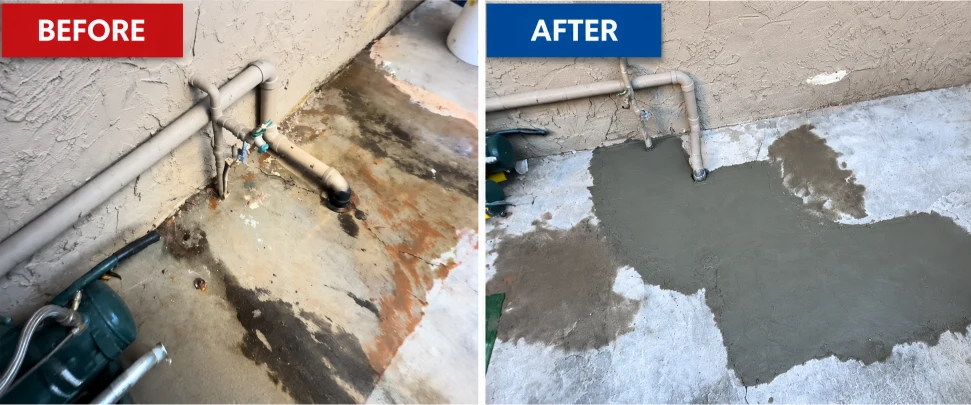
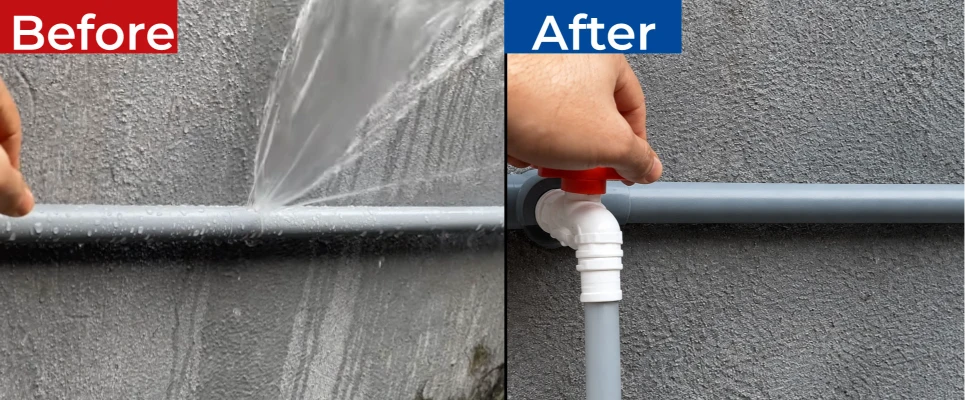
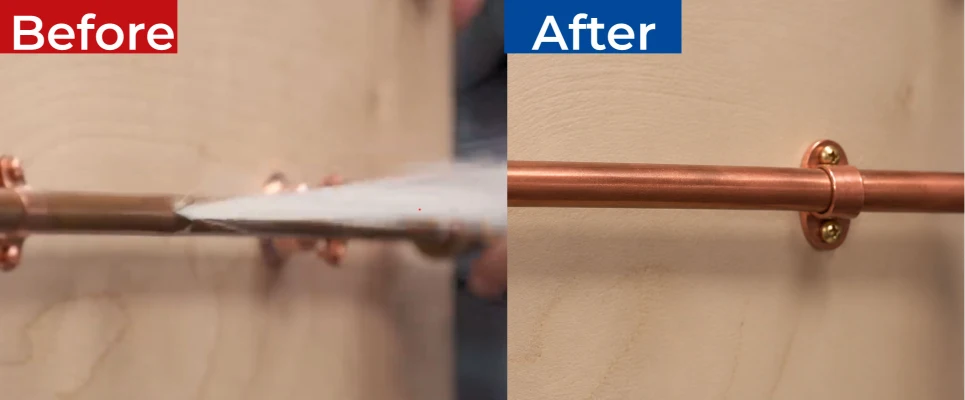
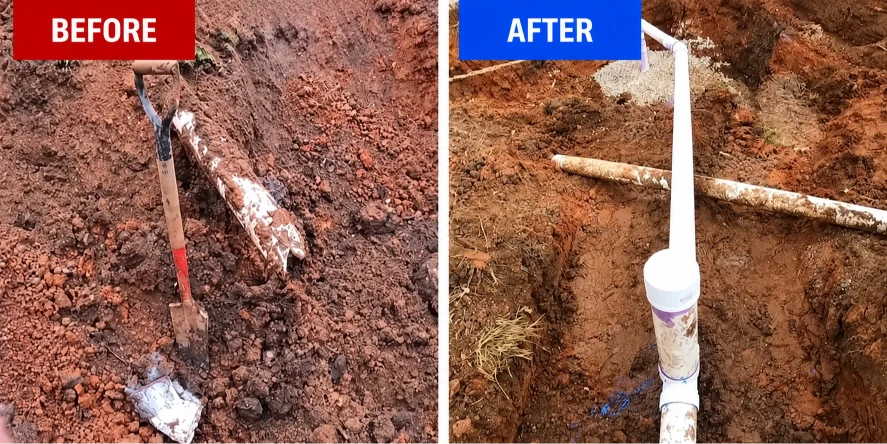
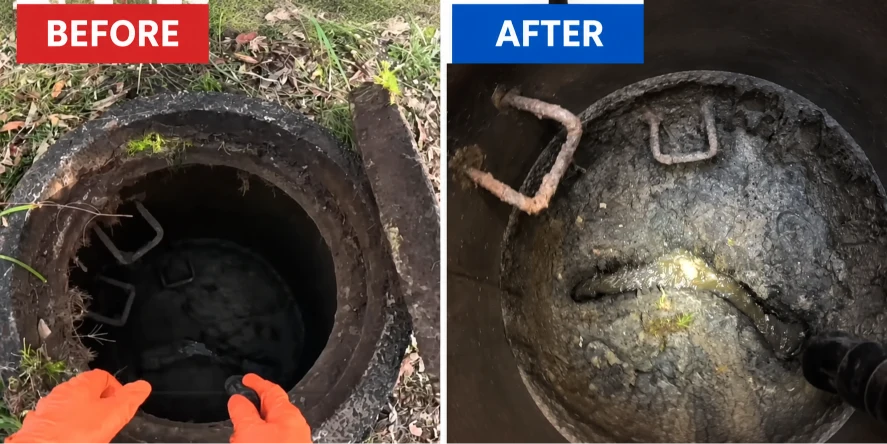
Photos are illustrative examples of typical repairs.
Our slab leak repair process, from first call to patched floor
No concrete is cut until the leak is confirmed, pinpointed and explained, and you’ve approved an upfront price.
- You callTell us what you’re noticing and what the meter test showed. We’ll tell you if it’s a shut-the-main-now situation.
- We confirm the leakMeter, isolation and pressure tests show whether it’s the hot side, the cold side, the yard line or a drain.
- We pinpoint itAcoustic listening, thermal imaging and line tracing mark the spot on your floor.
- You see the evidenceReadings, photos or camera video, explained in plain words.
- You get your options and an upfront priceSpot repair, tunnel, reroute or repipe, with the tradeoffs. No work starts until you approve.
- We protect your homeFloor coverings, dust control, and furniture moved before any concrete is cut.
- We repair and testThe line is repaired or replaced and pressure-tested before anything is closed up.
- We close up and documentConcrete patched, plus photos and written notes for your insurance claim and your records.
How long does slab leak repair take, and can I stay home?
Detection is usually done in one visit. A spot repair is often finished in a day, though new concrete needs time to cure before flooring goes back. Reroutes and repipes take longer, depending on the home. Most families stay home; you may be without water for part of the day while lines are switched over.
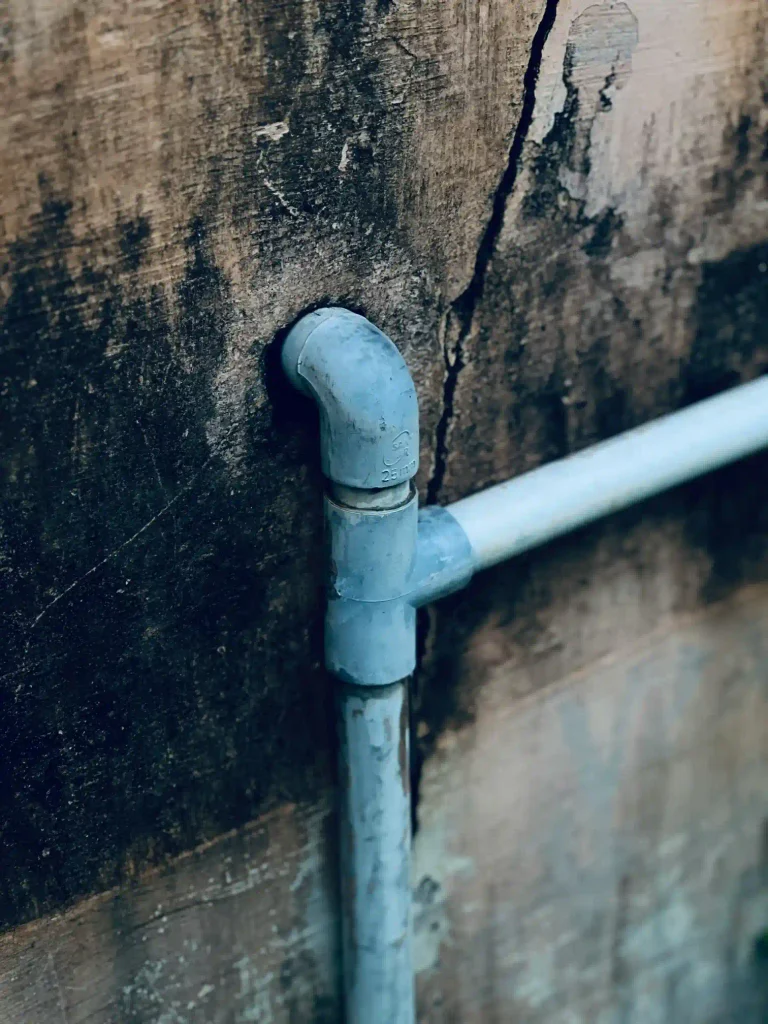
What we never do: open a floor to “go looking”, start work before you approve the price, or recommend a repipe without showing you why.
What affects the cost of slab leak repair in New Braunfels
Every slab leak is different, so any number online is a guess about someone else’s house. These are the things that actually change the price of yours.
- How hard the leak is to find: one clear hot spot vs a quiet cold-water leak
- Repair method: spot repair, tunnel, reroute or repipe
- Where the leak sits: open slab vs under cabinets, a tub or finished tile
- Water vs sewer line: sewer work often means tunneling and a hydrostatic test
- Pipe material and age: sound PEX vs aging copper or cast iron
- What’s above it: flooring that must come up and go back down
- Permits and inspection, where the work requires them
Our pricing promise
You get an upfront price before we start, and nothing changes without your OK.
How much does slab leak repair cost in New Braunfels?
It depends on how the leak is found, which repair you choose, where the leak sits and what flooring is above it. A spot repair, a tunnel and a reroute are very different jobs. Call us for a price on your home; you get an upfront price before any work starts.
Slab leaks and homeowners insurance in Texas
Will homeowners insurance cover a slab leak?
Sometimes. Many Texas policies cover water damage from a sudden plumbing leak and may pay to break and replace the slab to reach the pipe, but often not to repair the pipe itself. Gradual leaks and soil movement are commonly excluded. Coverage varies by policy, so check yours and document everything before repairs.
What to know
- Policies often treat the damage the water caused differently from the pipe that failed.
- The Texas Department of Insurance said in a 1997 bulletin that foundation damage from an accidental discharge of water from plumbing was a covered loss under the standard HO-B policy, while tear-out coverage could be limited by endorsement. That guidance is old, and policies today vary widely.
- Gradual, long-term leaks and soil movement are commonly excluded.
- Read your own policy or ask your agent before you assume either way.
What to document for your claim
- Photos and video of the damage before anything is moved
- Your meter test results, NBU alerts and recent bills
- Our written findings: leak location, which line, method used
- Photos of the opened slab and the failed pipe
- Receipts for drying, mitigation and repair
We give you the written findings and photos your adjuster will ask for.
Slab leaks and your foundation: who to call first
Plumbers and foundation crews in New Braunfels often work on the same houses. Doing the work in the right order saves you paying for something twice.
Can a slab leak damage my foundation?
Yes. Water from a slab leak saturates the soil under the foundation. Expansive clay swells when wet, which can lift or tilt part of the slab and crack tile, drywall and the slab itself. A leak can also wash out supporting soil. The longer it runs, the more the soil under that area changes.
Do I need a plumber or a foundation company first?
Usually the plumber first. Foundation repair on top of an active leak can fail as the soil keeps moving. Find and stop the leak, then have the foundation evaluated. Many foundation companies ask for a hydrostatic sewer test before or after leveling, because lifting a slab can stress pipes. The trades work best in sequence.
The right order
- Stop the leak (plumber).
- Test the drains if foundation work is planned (hydrostatic test).
- Have the foundation evaluated by a foundation engineer or repair company.
- Re-test the lines after leveling, since lifting a slab can stress pipes.
How to prevent slab leaks in New Braunfels
You can’t control the clay, but you can control most of what wears pipes out faster.
Keep foundation soil moisture steady
In long dry spells clay pulls away from the slab. Water evenly around the foundation, don’t flood it, and follow current NBU watering stage rules.
Check your water pressure
Very high pressure stresses every joint. A pressure-reducing valve (PRV) protects pipes, fixtures and the water heater.
Treat hard water
Mineral buildup ages pipes and water heaters. A softener or filter slows it down. Water softeners
Act on the first leak
One pinhole in old copper is often a warning about the rest of the same line.
Run a meter test twice a year
And anytime your bill jumps. It takes five minutes and catches leaks early.
Know where your shut-off is
Find the main shut-off before you need it, so a surfacing leak doesn’t turn into a flooded room.
Should I water my foundation in a drought?
Many New Braunfels builders recommend it. In drought, clay soil shrinks and pulls away from the foundation, letting the slab settle unevenly. Watering evenly around the perimeter keeps moisture steady. Don’t flood one spot, which can cause the swelling you’re trying to avoid, and follow NBU’s current watering stage rules.
Will the slab leak come back?
The repaired spot shouldn’t, but other spots on the same pipe can. The pipe under your slab has been through the same soil movement and water everywhere. After two or more leaks, a reroute or repipe usually makes more sense than repeated spot repairs. We’ll show you what we see in the pipe.
Do I need a City permit for slab leak repair or a reroute?
Plumbing work in Texas cities often requires a permit pulled by a licensed plumber, and larger jobs like reroutes and repipes commonly need inspection. Requirements depend on the scope of work. A licensed plumber should know what the City of New Braunfels Building Safety division requires for your job. Ask before work starts.
How we compare to a typical slab leak call
The difference is mostly in what happens before anyone picks up a jackhammer.
| Typical slab leak call | New Braunfels Plumbing Tx | |
|---|---|---|
| Confirming the leak | ✗ Sometimes quotes on symptoms alone | ✓ Meter, isolation and pressure tests first |
| Before breaking concrete | ✗ May open the floor to “look” | ✓ Acoustic, thermal and line tracing to pinpoint |
| Drain lines under the slab | ✗ Water lines only | ✓ Hydrostatic test when signs point to sewer |
| Repair options | ✗ One option offered | ✓ Spot, tunnel, reroute and repipe compared |
| Price | ✗ Price changes after the job starts | ✓ Upfront price before we start |
| Insurance paperwork | ✗ An invoice only | ✓ Written findings and photos |
| License | ? Not always stated | ✓ Licensed by the TSBPE |
Slab leak repair across New Braunfels and Comal County
Where your home sits and when it was built changes what usually fails under the slab. We serve New Braunfels (78130, 78132) on both sides of I-35. Call to check plumber availability for your area.
Established neighborhoods
Downtown, the Landa Park area, Gruene, River Chase, Kinwood, Mission Valley Estates, River Tree and Oak Run.
Older homes here have had more years of soil movement under them, and some sit on pier-and-beam rather than a slab. Aging copper supply lines and older drain lines under the floor are the usual suspects.
Newer communities
Veramendi, Mayfair, Meyer Ranch, Steelwood Trails, Parkside, Voss Farms, Overlook at Creekside, Legacy at Lake Dunlap and Enclave at Westpointe Village.
Slab leaks in a home’s first years often trace back to lines damaged during construction or early settling. Check your builder’s warranty before you pay for a repair, and keep our written findings for the builder.
Rural and nearby
Vintage Oaks, Solms, Canyon Lake and the rest of Comal County.
Longer runs from the meter to the house make a yard-line leak just as likely as a slab leak, so the meter test matters even more before anyone looks at the floor.
Slab leak questions people also ask
Do plumbers fix slab leaks?
Yes. A licensed plumber detects and repairs slab leaks, and some also specialize in electronic leak detection. In Texas, plumbing work should be done by a plumber licensed by the Texas State Board of Plumbing Examiners (TSBPE).
Can I keep using water with a slab leak?
For a slow leak, briefly, with the main off when you don’t need water. If water is surfacing or the meter is spinning fast, keep the main off until it’s repaired.
Does a slab leak cause mold?
It can. Constant moisture under flooring and in the bottom of walls feeds mold and mildew. Dry the area properly after the repair.
Do pier-and-beam homes get slab leaks?
Not in the same way. Pier-and-beam homes have a crawl space, so the pipes can usually be reached without breaking concrete.
Will my floors be ruined?
Not necessarily. Pinpoint detection keeps any opening small, and a reroute avoids breaking the floor at all.
Think you have a slab leak? Let’s find it before anything gets broken.
Run the meter test, then call. We’ll tell you what the reading means, when a plumber can get there, and give you an upfront price before any work starts.
Licensed by the TSBPE · Call us to check plumber availability
Have this ready when you call
- What the meter did with everything off
- Where the warm spot, damp floor or sound is
- When the bill jumped or the NBU alert came
- Photos of any damage or cracks
- Your home’s age, and any past slab leaks
About us
New Braunfels Plumbing Tx is a local plumbing service for homes across New Braunfels and Comal County, focused on emergencies, slab leaks, water heaters, drains and NBU water issues.
Contact
New Braunfels Plumbing Tx4665 FM 482, New Braunfels, TX 78132
(830) 218-7472
support@newbraunfelsplumbingtx.com
Mon–Fri 7 AM–7 PM · Sat–Sun 8 AM–5 PM
Call to check plumber availability
Licensed by the TSBPE
Sources
Community Impact, “Foundation issues on the rise in New Braunfels” (July 14, 2023); Texas Monthly, “Texas Primer: The Balcones Escarpment”; Texas Department of Insurance, Bulletin B-0032-97 (1997); New Braunfels Utilities, continuous water use guidance; Texas State Board of Plumbing Examiners.