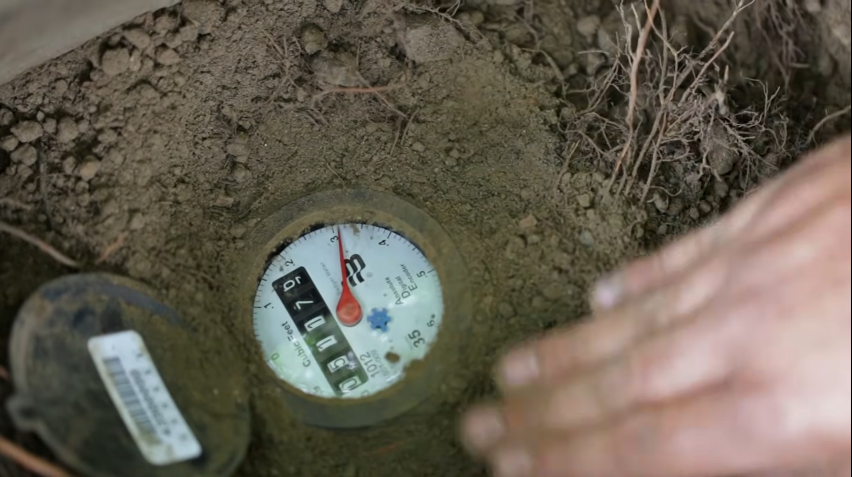
Hidden leak detection
Leak Detection in New Braunfels, TX
Your meter is moving, your bill doubled, or NBU texted you about continuous water use, and you can’t see a drop anywhere. We find where the water is going before anyone opens a wall, a floor or your yard.
- The leak located and marked, not guessed
- A written leak report for NBU and your insurer
- Upfront price before we start
Licensed by the TSBPE · Call us to check plumber availability
9,300+ gallons
What an average household’s leaks can waste in a year.
EPA WaterSense
20–100 gal/hour
The flow NBU says may point to an underground leak.
New Braunfels Utilities
0 repairs
What NBU does on your side of the meter: it “does not provide plumbing services or leak repairs.”
New Braunfels Utilities
Where is your leak? Match what you’re seeing to where it usually is
Most hidden leaks give themselves away. Match the strongest sign you have to the likely source, and you’ll know what kind of search to expect.
| What you notice | Most likely source | How it’s confirmed |
|---|---|---|
| Meter moves, nothing visible, and a warm spot on the floor | Hot water line under the slab | Isolation test, thermal imaging, acoustic. See slab leak repair |
| Meter moves, a soggy or extra-green strip in the yard | Yard service line between the meter and the house | Meter test with the house shut-off closed, line tracing, acoustic |
| Hissing in a wall, bubbling paint, a stain on drywall or ceiling | Supply line or fitting inside a wall | Moisture meter, thermal imaging, acoustic |
| Toilet refills by itself, bill up a little | Toilet flapper or fill valve | Dye test |
| Bill jumps in summer, wet spots near sprinkler heads | Irrigation line or valve | Irrigation zone shut-off test |
| Pool drops faster than usual | Pool plumbing or shell, not your house plumbing | Bucket test, then a pool leak specialist |
| Water heater runs constantly, water at its base | Water heater, T&P valve or drain valve | Visual check and isolation. See water heater repair |
| Sewer smell, slow drains, damp floor near a bathroom | Drain line (doesn’t move the meter) | Camera inspection, hydrostatic test. See sewer line repair |
How do I know if I have a hidden water leak?
Turn off every faucet, appliance and the irrigation, then watch your water meter’s leak indicator for two to three minutes. If it moves, water is going somewhere. Other signs are an unexplained bill increase, an NBU continuous-use alert, the sound of running water, damp drywall, a warm floor or a soggy patch of yard.
How much water can a small leak waste?
More than most people expect. The EPA says an average household’s leaks can waste more than 9,300 gallons a year, and about 9% of homes have leaks wasting 50 gallons or more a day. A toilet flapper leak alone can run all day without making a sound, which is why meter checks matter.
The 3-minute meter test: inside the house or out in the yard?
Shut everything off
Faucets, toilets, washer, dishwasher, ice maker, softener and sprinklers. Then open your meter box, usually near the street in a green round NBU box, and find the small leak indicator.
Watch the indicator
If it doesn’t move for 2 to 3 minutes, you likely have no active leak. If it moves, close your home’s main shut-off valve, often near the front hose bib or where the line enters the house.
Read the result
Meter stops: the leak is inside the house (toilet, water heater, wall or slab).
Meter keeps moving: the leak is in the yard line between the meter and your house.
My water meter is running but I can’t find a leak. What should I do?
First rule out toilets with a dye test and make sure irrigation, the softener and any pool auto-fill are off. Then close the house shut-off. If the meter stops, the leak is inside the home, often in a wall or under the slab. If it keeps moving, it’s the yard line. Either way, a plumber can pinpoint it electronically.
Is the leak inside my house or in the yard line?
Close your home’s main shut-off and watch the meter. If the leak indicator stops, the leak is inside the house. If it keeps moving with the house shut off, the water is escaping between the meter and the house, in the yard service line, which is your responsibility to repair, not NBU’s.
NBU, your meter and your leak: who’s responsible for what
New Braunfels Utilities’ Service Conditions Policy draws a clear line. NBU is responsible for its system up to and including the point of delivery. Everything past that point is the customer’s to maintain, including excessive water use caused by leaks.
NBU’s side
- Water mains and the system up to the point of delivery
- The meter and its box
- Continuous-use alerts from your meter
- Leak adjustments, if you qualify
Your side
- Pipes and equipment past the point of delivery
- The yard line to the house, all indoor plumbing, irrigation, pool and softener
- Finding and repairing the leak
- Proof of the repair (a receipt) for any adjustment
“NBU does not provide plumbing services or leak repairs.”From NBU’s own continuous water use page. If the leak is on your side, you need a licensed plumber.
Who is responsible for a leak, NBU or me?
Under NBU’s Service Conditions Policy, NBU maintains its system up to and including the point of delivery, generally the meter. The homeowner is responsible for everything beyond it, including the yard line, indoor plumbing and the extra water a leak uses. If water is leaking on NBU’s side of the meter, report it to NBU.
What does an NBU continuous water use alert mean?
It means your meter recorded water flowing without stopping. NBU’s guide says 2 to 5 gallons per hour is often a toilet flapper, 8 to 30 is often a hose, pool fill or softener cycle, and 20 to 100 may mean an underground leak. Run a meter test, then call a plumber if you can’t find it.
What NBU’s flow numbers usually point to
Bars drawn on a 0 to 100 gallons-per-hour scale. Ranges from NBU’s continuous water use guide.
Will NBU adjust my water bill for a leak?
Possibly. NBU’s policy allows an adjustment for single-family homes when the leak was in household plumbing and you provide a repair receipt. Only bills within 45 days of the repair are considered. NBU compares usage with the same period in the two previous years and bills the extra gallons at the lowest rate classification.
Why doesn’t NBU’s leak adjustment cover my pool or sprinklers?
NBU’s policy only covers leaks in household plumbing. Filtering systems, pools, recreational equipment and irrigation systems are not eligible, and neither is water left running by accident, like a hose or faucet. That’s why it matters to know exactly where the leak was before you apply for an adjustment.
What to keep for an NBU leak adjustment
- The receipt for the repair (NBU requires it)
- The repair date: only bills within 45 days of it are considered
- Our written leak report: where, which line, how it was found
- Photos of the leak and the repair
- Your NBU alert texts and the bills that show the spike
Residents say adjustments can take time. One neighbor in a local group said hers took months and she “stayed on it.” Keep copies of everything and follow up.
Things that look like a leak but aren’t
Before anyone searches walls and floors, rule out the three things that most often trip an NBU alert or spike a bill without a leak.
Often not a leak
Irrigation run times
NBU says a sprinkler zone can use around 1,500 gallons, usually early morning or late evening. A changed controller setting can double a bill with no leak at all.
Often not a leak
Pool or hot tub filling
8 to 30 gallons an hour on NBU’s scale, the same range as a running hose. Check the auto-fill.
Often not a leak
Softener regeneration
8 to 30 gallons an hour for 1 to 2 hours, often overnight, which can trigger a continuous-use alert.
Could my irrigation system or water softener look like a leak?
Yes. NBU notes that softener regeneration runs 8 to 30 gallons per hour for one to two hours, and an irrigation zone can use about 1,500 gallons. Both can trigger an alert or spike a bill. Check the controller schedule and softener timer before assuming a hidden leak, then run a meter test with both off.
How do I tell a pool leak from a plumbing leak?
Use the bucket test. Set a bucket of pool water on a pool step, mark the water level inside the bucket and on the pool wall, turn off the auto-fill, and run the pump normally for a full day. If the pool drops more than the bucket, the pool is likely leaking. Pool leaks need a pool leak specialist.
How we find hidden leaks without tearing up your home
No single tool finds every leak. We match the method to the line and the signs, and we tell you what each test can and can’t show.
How do plumbers find hidden leaks without tearing up walls or floors?
They isolate the leaking line with meter and pressure tests, then pinpoint the spot with acoustic equipment that hears escaping water, thermal cameras that show temperature changes, moisture meters, and tracer gas for tiny or underground leaks. Line tracing maps where the pipe runs. Only the small area over the marked spot is opened for the repair.
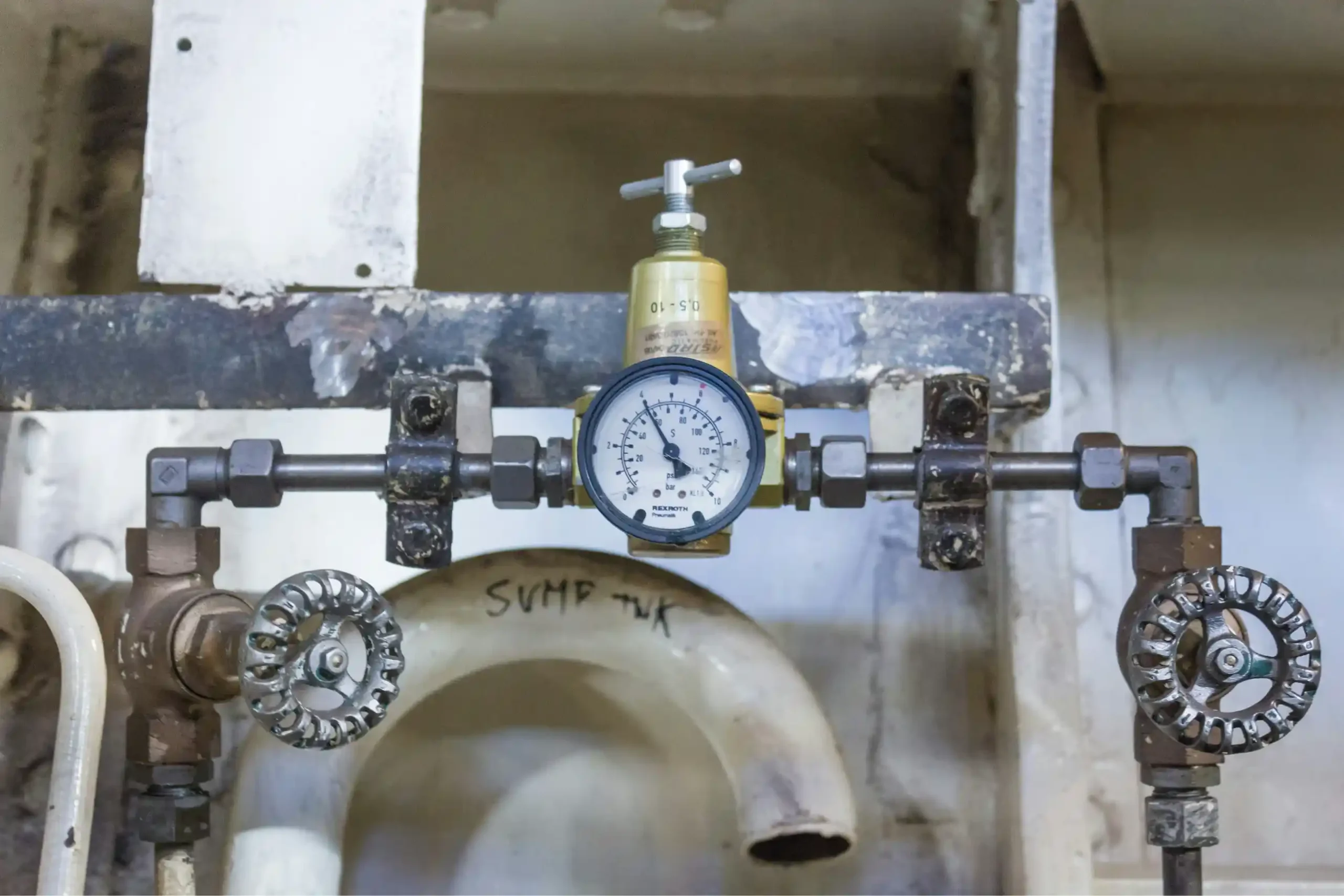
| Method | What it finds well | What it won’t find |
|---|---|---|
| Meter and isolation testing | Which side is leaking: hot, cold or yard line | The exact spot |
| Pressure testing | Whether a closed line holds pressure | Leaks on drains, which aren’t pressurized |
| Acoustic listening (ground microphone) | Water escaping under pressure through concrete, walls or soil | Very slow drips or drain leaks |
| Thermal imaging | Hot-water leaks and wet areas behind drywall | Cold leaks deep under a slab |
| Moisture meter | How far water has spread in drywall, trim or flooring | Where the pipe actually failed |
| Tracer gas (safe hydrogen-nitrogen mix) | Tiny leaks in long yard lines and under slabs | Drain lines |
| Line tracing | Where the pipe actually runs underground | The leak itself |
| Camera and hydrostatic test | Cracked or separated drain lines | Supply line leaks |
Can a plumber detect a leak behind a wall?
Yes. Thermal imaging and moisture meters show where water is soaking drywall, and acoustic listening picks up pressurized water escaping inside the wall. Together they narrow the leak to a small area, so the wall is opened once, in the right place, instead of cut open in several spots.
What’s the difference between acoustic, thermal and tracer gas leak detection?
Acoustic detection listens for pressurized water escaping and works through concrete, walls and soil. Thermal imaging shows temperature differences, so it’s best for hot-water leaks and wet drywall. Tracer gas pushes a safe hydrogen-nitrogen mix through the line and detects where it escapes, which helps find very small leaks or leaks in long yard lines.
Yard line leaks in New Braunfels: finding a pipe nobody marked
The line from your NBU meter to your house is private, and that matters when it leaks. Texas811 marks utility lines for free, but private lines past the meter are not marked. The property owner is responsible for having them located. That’s where line tracing and acoustic listening come in: we find where your line runs and where it’s leaking before anyone digs.
Rocky Hill Country lots and expansive clay soils both make digging in the wrong place slow and expensive, so pinpointing first saves the most here.
Do I need to call 811 before a yard leak is dug up?
Yes. Texas811 says anyone breaking ground, including homeowners and hand digging, must contact Texas811 at least two working days before digging. The locate is free, but it won’t mark your private water line past the meter. A plumber has to trace that line so the repair dig lands in the right place.
Our leak detection process
Six steps from your first call to a marked leak and a written report. Nothing is opened until you’ve seen the evidence and approved an upfront price.
- Phone triageTell us what the meter did, what NBU’s alert said and what you’re seeing. We’ll tell you if you should shut off the main now.
- ConfirmMeter, dye and isolation tests show whether it’s a toilet, the yard line, the hot side or the cold side.
- PinpointAcoustic, thermal, moisture and, when needed, tracer gas narrow it to one spot.
- Mark and showWe mark the spot and show you the readings and photos.
- Options and priceRepair, reroute or replace, explained, with an upfront price. No work starts until you approve.
- ReportA written leak report with the location, line, method and photos, ready for NBU and your insurer.
How long does leak detection take?
Most residential leak detection is done in a single visit. A toilet or yard-line leak can be confirmed quickly, while a quiet cold-water leak under a slab or a long rural yard line can take longer. You’ll know where the leak is, and your options, before the visit ends.
What happens after the leak is found?
You get the location marked, the evidence explained and your repair options with an upfront price. A wall leak is usually opened at one spot and repaired. A slab leak may be repaired, tunneled or rerouted. A yard line is repaired or replaced. You also get a written report for NBU and insurance.
What’s in your written leak report
A leak isn’t just a repair. It’s often an NBU adjustment request and sometimes an insurance claim, so you get the paperwork both will ask for.
Leak detection report
- Address, date, and what the meter showed before and after isolation
- Which line was leaking (hot, cold, yard or drain) and the methods used
- The marked location, with photos
- The recommended repair and the options you were given
- The repair date and receipt reference, for NBU’s 45-day window
DIY, a general plumber, or leak detection: which do you need?
Best for: confirming a leak
Do it yourself
The meter test, dye test and bucket test are free and take minutes. They tell you if there’s a leak and roughly where, but not the exact spot.
Best for: visible leaks
General plumbing visit
A dripping fixture, a leaking supply line under a sink or a running toilet doesn’t need detection equipment. A plumber can fix it directly.
Best for: leaks you can’t see
Leak detection
Meter moving, no visible water, a warm floor, a soggy yard or an NBU alert you can’t explain. Pinpointing first avoids opening walls, floors or yards in the wrong place.
Should I hire a leak detection specialist or a plumber?
If you can see the leak, a plumber can usually fix it directly. If you can’t, choose a plumber who does electronic leak detection, so the leak is pinpointed before anything is opened. Many residents prefer detection first because guessing leads to extra holes. In Texas, the repair itself should be done by a TSBPE-licensed plumber.
What affects the cost of leak detection in New Braunfels
- Where the leak is likely to be: wall, slab, yard line or fixture
- How quiet it is: a hot-water hiss vs a slow cold-water seep
- Line length and access: long rural yard lines, finished floors, landscaping
- Methods needed: acoustic only, or tracer gas and line tracing
- Whether you need a report for NBU or insurance
How much does leak detection cost in New Braunfels?
It depends on where the leak is likely to be, how hard it is to hear, how long and accessible the line is, and which methods are needed. A toilet check and a slab or long yard-line search are very different jobs. Call us for an upfront price before any work starts.
Where is my water shut-off in New Braunfels?
Most homes have a main shut-off near where the line enters the house, often near the front hose bib or garage. NBU’s customer shut-off is near the street between property lines, often in a green round box with a wagon-wheel handle. A guest house usually has no separate shut-off; the water heater’s cold-inlet valve isolates the heater.
Shut-off checklist
- Find your house shut-off before you need it
- Know where the green NBU box is near the street
- Test that the valve turns, gently
- If a valve is stuck, call a plumber rather than forcing it
Who needs leak detection here, and what time of year
Problem types
Who this is for
- Homeowners who got an NBU continuous-use alert
- Owners of second homes who see usage while nobody is there
- Buyers and sellers who want a leak-free report before closing
- Property managers handling a tenant’s high-bill complaint
When it happens most
- Summer: irrigation and pool auto-fills make bills jump, so we rule them out first
- After a freeze: cracked lines in attics, walls and yard pipes start leaking as they thaw
- Drought to rain swings: shifting clay opens new leaks under slabs and in yard lines
- Before a trip: a meter test before you leave catches slow leaks early
Leak detection before and after: from “somewhere” to one small repair
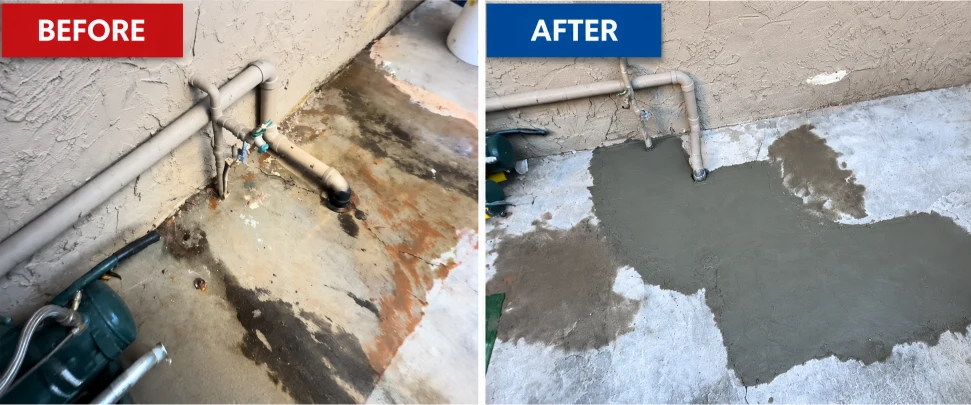
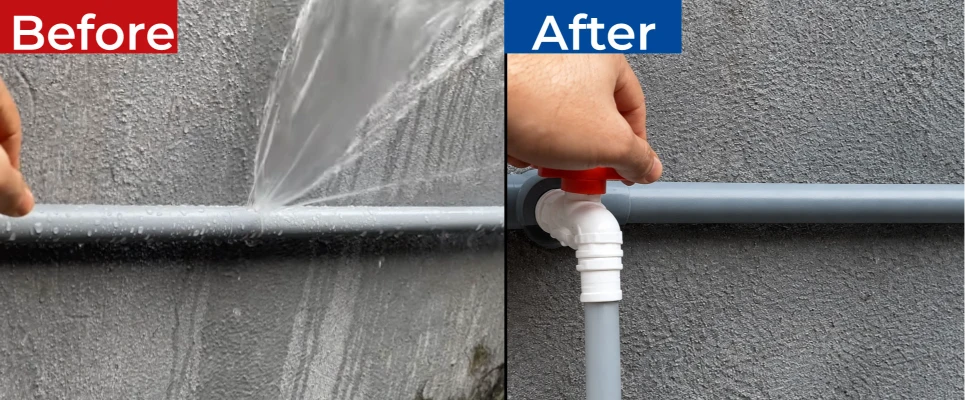
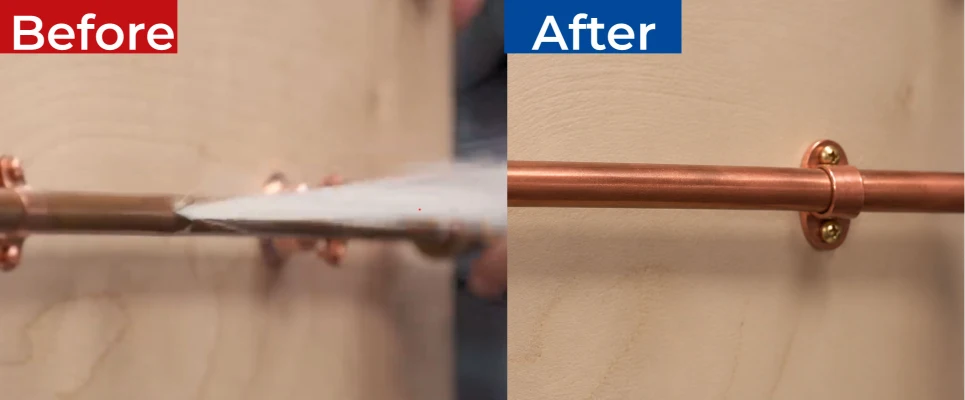
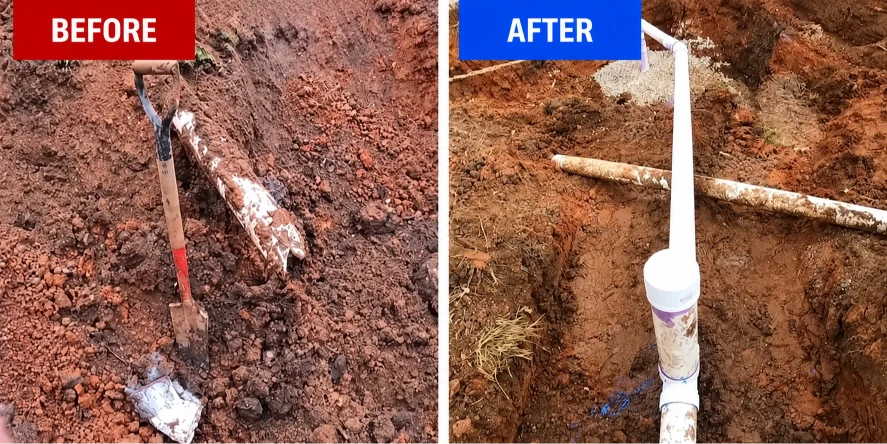
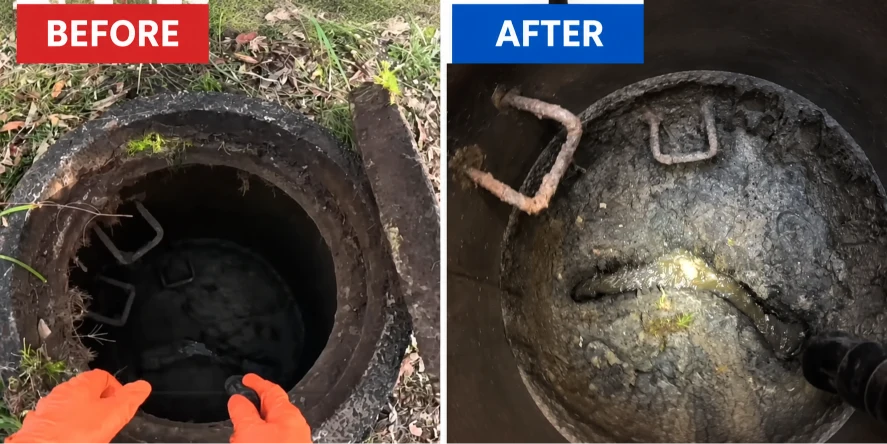
Photos are illustrative examples of typical repairs.
Leak detection for New Braunfels homes on NBU water and beyond
NBU customers in New Braunfels
78130 and 78132: downtown, Gruene, the Landa Park area, Veramendi, Mayfair, Meyer Ranch, Creekside and neighborhoods on both sides of I-35. NBU alerts, adjustments and policy apply.
Homes outside NBU’s service area
Around Canyon Lake, Garden Ridge, Seguin and rural Comal County, your water provider may not be NBU. The meter test works the same way, but alerts and leak-adjustment rules are your provider’s, so check with them.
Long rural lines
Acreage homes with long runs from the meter to the house, where line tracing and tracer gas matter most before anyone digs.
Call to check plumber availability for your area.
More leak detection questions
Can a leak raise my bill even if I can’t hear it?
Yes. Most toilet flapper leaks and slow yard-line leaks are silent. The meter is the reliable test.
Should I turn off my water heater if I have a leak?
If the leak is on the hot side, or you’ve shut off the main for long, turn the heater off (gas to pilot, or flip the breaker) so it doesn’t run empty.
Will my homeowners insurance pay for leak detection?
Policies vary. Some cover the cost to find and reach a covered leak, but not the pipe repair. Ask your agent and keep the leak report.
Do new homes get hidden leaks?
Yes. Fittings, nail punctures in walls and lines damaged during construction can leak in a home’s first years. Check your builder’s warranty.
Can freezing weather cause hidden leaks?
Yes. During the February 2021 winter storm, NBU said residential leaks and burst pipes likely caused the water outages. A cracked pipe can leak slowly long after it thaws.
Before you call, check these three things
- What did the meter do with everything off, and with the house shut-off closed?
- Did the toilet dye test show color in the bowl?
- Are irrigation, the softener and pool auto-fill off?
Then call. We’ll tell you what your answers mean, when a plumber can get there, and give you an upfront price before any testing starts.
Licensed by the TSBPE · Call us to check plumber availability
About us
New Braunfels Plumbing Tx is a local plumbing service for homes across New Braunfels and Comal County, focused on emergencies, slab leaks, water heaters, drains and NBU water issues.
Contact
New Braunfels Plumbing Tx4665 FM 482, New Braunfels, TX 78132
(830) 218-7472
support@newbraunfelsplumbingtx.com
Mon–Fri 7 AM–7 PM · Sat–Sun 8 AM–5 PM
Call to check plumber availability
Licensed by the TSBPE
Sources
New Braunfels Utilities, Service Conditions Policy (Oct 1, 2023 update) and Continuous Water Use Alerts page; NBU customer shut-off video (Feb 4, 2022); U.S. EPA WaterSense, Fix a Leak Week; Texas811 FAQ; Community Impact (Feb 18, 2021); Texas State Board of Plumbing Examiners.